
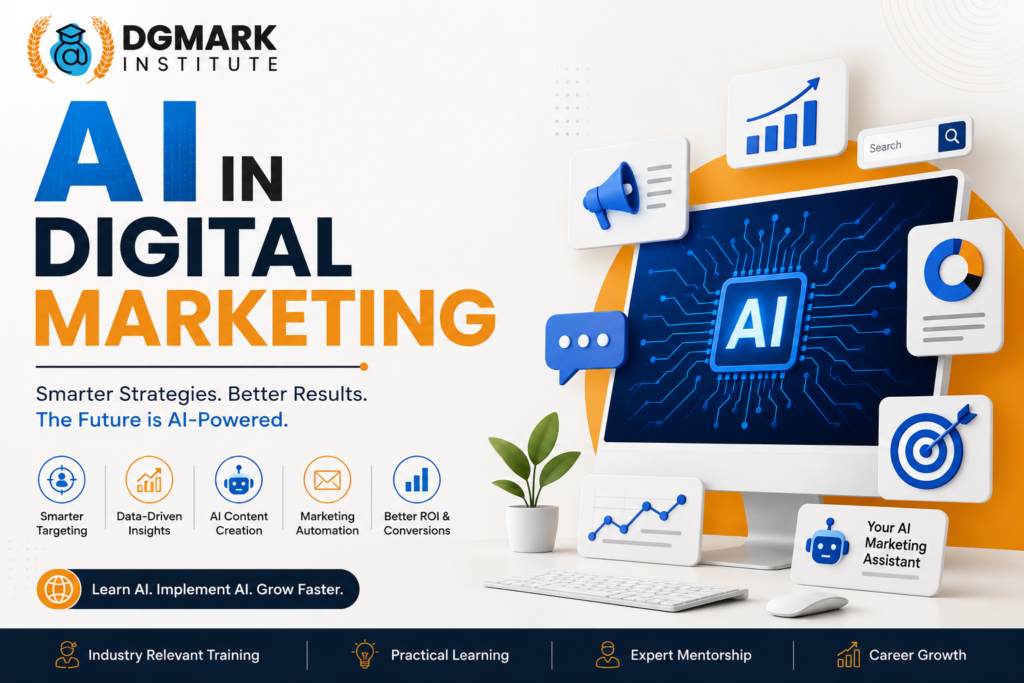
AI in Digital Marketing is changing the way businesses attract customers, create content, analyze data, and build digital marketing strategies. For students, professionals, and business owners who want to stay competitive, understanding AI has become an important digital marketing skill. DGmark Institute recognizes this shift and incorporates AI tools into its digital marketing curriculum, helping learners understand how AI can be applied to content creation, SEO, social media, advertising, automation, and marketing analytics. As AI continues to evolve, marketers who know how to combine technology with creativity and strategy will have a significant advantage in the digital landscape.
What Is AI in Digital Marketing?
AI in digital marketing refers to the use of artificial intelligence technologies to automate tasks, analyze information, understand customer behavior, generate content, and improve marketing decisions.
Traditional digital marketing often requires marketers to manually collect data, analyze customer behavior, create content, manage campaigns, and optimize advertisements. AI can make many of these processes faster and more efficient.
AI-powered marketing tools can identify patterns in large amounts of data, generate content ideas, suggest keywords, analyze campaigns, personalize customer experiences, and automate repetitive activities.
However, AI is not simply about replacing human work. Its biggest value comes from helping marketers work more efficiently and make better-informed decisions.
A successful marketer can use AI for speed and efficiency while using human creativity, experience, emotional understanding, and strategic thinking to make the final decisions.
Why Is AI Important in Digital Marketing?
The digital marketing industry generates a huge amount of data every day. Businesses receive information from websites, social media platforms, search engines, advertising campaigns, email marketing, and customer interactions.
Analyzing all this information manually can take considerable time.
AI helps marketers process data faster and identify useful insights.
For example, AI can help marketers:
- Analyze customer behavior
- Identify content trends
- Generate marketing ideas
- Create advertising copy
- Research keywords
- Personalize customer experiences
- Automate repetitive tasks
- Analyze campaign performance
- Predict possible customer behavior
- Improve marketing workflows
This allows digital marketers to spend more time on strategy and creative thinking instead of repetitive tasks.
Modern digital marketing education is therefore increasingly incorporating AI into traditional marketing skills. DGmark Institute, for example, includes AI tools as part of its digital marketing curriculum and focuses on practical exposure to tools that marketers can use in real-world situations.

How AI Is Changing Digital Marketing
AI is influencing almost every major area of digital marketing. Let’s look at some of the most important applications.
1. AI for Content Creation
Content marketing is one of the areas where AI has made a significant impact.
Marketers regularly need to create:
- Blog ideas
- Social media captions
- Ad copy
- Email content
- Product descriptions
- Video scripts
- Headlines
- Content outlines
AI tools can help generate initial ideas and drafts within seconds.
For example, a marketer can provide a topic and ask an AI tool to suggest blog titles, content ideas, social media posts, or advertising messages.
However, AI-generated content should not simply be published without review.
Human marketers still need to check:
- Accuracy
- Brand voice
- Originality
- Relevance
- Readability
- Audience expectations
The best approach is to use AI as a creative assistant rather than depending entirely on it.
2. AI in SEO
Search Engine Optimization is another area where AI is becoming increasingly important.
SEO involves keyword research, content optimization, competitor analysis, technical improvements, link-building strategies, and understanding search intent.
AI can help marketers organize and analyze large amounts of search-related information.
Some common applications include:
- Keyword research
- Keyword clustering
- Search intent analysis
- Content ideas
- Content outlines
- Competitor research
- Meta title suggestions
- Meta description ideas
- Content optimization
- SEO audits
AI can make SEO research faster, but it does not eliminate the need for SEO knowledge.
A marketer still needs to understand search intent, website structure, content quality, technical SEO, user experience, and Google’s guidelines.
This is why learning SEO together with AI can be valuable for aspiring digital marketers.
3. AI for Social Media Marketing
Social media marketers have to consistently create content and maintain engagement across multiple platforms.
AI can assist with several social media activities.
For example, marketers can use AI to:
- Generate content ideas
- Create captions
- Suggest hashtags
- Build content calendars
- Develop social media strategies
- Create creative concepts
- Analyze engagement patterns
- Repurpose existing content
Imagine a business wants to create one month’s worth of Instagram content.
Instead of starting from scratch, a marketer can use AI to brainstorm themes, post ideas, captions, hooks, and content formats.
The marketer can then refine these ideas according to the brand’s identity and target audience.
AI therefore makes the content planning process faster while allowing marketers to focus more on creativity and execution.
4. AI in Performance Marketing
Performance marketing depends heavily on data.
Marketers need to monitor metrics such as:
- Click-through rate
- Cost per click
- Cost per lead
- Conversion rate
- Return on ad spend
- Engagement
- Audience performance
AI can help marketers analyze campaign data and identify patterns.
For example, AI-powered systems can assist in identifying audience segments, optimizing advertising delivery, and generating variations of advertising copy.
This can be especially useful when running campaigns across platforms such as Google and Meta.
However, marketers still need to understand campaign objectives, targeting, creative strategy, budgeting, conversion tracking, and analytics.
AI can support optimization, but a strong marketing strategy still requires human decision-making.
5. AI-Powered Personalization
Customers increasingly expect brands to provide relevant experiences.
Instead of showing the same message to everyone, businesses can use data and AI to create more personalized experiences.
For example, an online store may recommend products based on a customer’s browsing behavior.
Similarly, an email marketing campaign can use customer information to deliver more relevant messages.
Personalization can be applied to:
- Email marketing
- Product recommendations
- Website experiences
- Advertising
- Content
- Customer communication
AI makes it easier for businesses to process customer information and deliver personalized experiences at scale.
6. AI Chatbots and Customer Support
AI-powered chatbots are becoming increasingly common on websites and digital platforms.
Businesses can use chatbots to answer frequently asked questions, provide basic information, collect leads, and guide customers toward relevant products or services.
For example, a digital marketing agency could use a chatbot to ask visitors about their business, marketing requirements, budget, and preferred services.
This can help businesses respond to potential customers quickly, even outside normal working hours.
However, human support remains important for complicated questions, complaints, and situations that require empathy or professional judgment.
7. AI for Marketing Analytics
Data is one of the most important parts of digital marketing.
Marketers need to understand what is working and what needs improvement.
AI can help analyze large amounts of marketing data and identify patterns that may not be immediately obvious.
For example, marketers can analyze:
- Website traffic
- User behavior
- Campaign performance
- Customer engagement
- Conversion data
- Audience segments
These insights can help businesses make better marketing decisions.
Instead of relying only on assumptions, marketers can use data to understand what customers are actually doing.
8. AI for Email Marketing
Email marketing is another area where AI can improve efficiency.
AI can help marketers create subject-line ideas, email content, audience segments, and campaign variations.
It can also assist marketers in determining which types of content may be more relevant to different audiences.
For example, a business selling multiple products may create different email campaigns for different customer groups.
AI can help marketers organize this information and develop more targeted communication.
The result can be a more relevant customer experience and a more efficient email marketing process.
9. AI in Graphic and Video Content
AI has also transformed visual content creation.
Today, marketers can use AI-powered tools to assist with:
- Image generation
- Graphic design
- Video creation
- Voice generation
- Video editing
- Background removal
- Creative variations
- Presentation design
This is especially useful for small businesses and marketers who may not have access to a large creative team.
AI can help turn an idea into an initial visual concept quickly.
However, marketers still need to understand design principles, branding, storytelling, audience psychology, and platform requirements.
Technology can help create the asset, but the marketer needs to decide what should be created and why.
AI Tools Digital Marketers Should Know
The AI ecosystem is growing rapidly, with new tools appearing regularly.
Depending on the marketing task, marketers may explore tools for:
- Text generation
- Content writing
- SEO
- Graphic design
- Video creation
- Voice generation
- Data analysis
- Social media management
- Marketing automation
- Research
DGmark Institute’s current curriculum highlights AI tools alongside core digital marketing skills. Its course material includes exposure to tools such as ChatGPT, Gemini, Canva AI, Adobe Firefly, Predis.ai, ElevenLabs, Runway, Midjourney, Perplexity, Copilot, and other AI platforms.
The important point is not to learn every AI tool available.
Instead, marketers should understand which tools are useful for particular marketing objectives and how to use them effectively.
Benefits of AI in Digital Marketing
AI provides several advantages for marketers and businesses.
Faster Workflows
Tasks that previously required hours of manual work can sometimes be completed much faster with AI assistance.
Better Data Analysis
AI can process large amounts of information and help marketers identify useful patterns.
Improved Productivity
Marketers can automate repetitive tasks and focus more on strategy and creativity.
More Content Ideas
AI can help marketers overcome creative blocks by generating new ideas and variations.
Personalization
Businesses can use AI to create more relevant experiences for different customer groups.
Marketing Automation
AI can support repetitive marketing processes, allowing businesses to operate more efficiently.
Better Decision-Making
When combined with reliable data, AI can provide insights that support more informed marketing decisions.
Challenges of Using AI in Digital Marketing
Although AI offers many advantages, marketers should also understand its limitations.
1. Accuracy Issues
AI can sometimes generate incorrect or misleading information. Marketers must verify important facts before publishing content.
2. Lack of Human Emotion
AI can generate text, but genuine storytelling and emotional connection still require human understanding.
3. Generic Content
If marketers depend too heavily on AI-generated content, their communication can become repetitive or lack personality.
4. Privacy Concerns
Businesses must handle customer data responsibly and follow applicable privacy and data-protection requirements.
5. Overdependence on Technology
AI should support marketing strategy rather than replace marketing knowledge.
The best marketers will understand both sides: how marketing works and how AI can improve it.
Will AI Replace Digital Marketers?
One of the most common questions among students and professionals is whether AI will replace digital marketing jobs.
The more practical way to look at the situation is that AI is likely to change the tasks marketers perform.
Marketers who use AI effectively may become more productive than marketers who ignore it.
AI can help with research, content ideas, analysis, automation, and optimization. But marketing still requires strategy, creativity, communication, customer understanding, brand positioning, and decision-making.
A business does not simply need content.
It needs the right content for the right audience at the right time with the right objective.
That requires strategic thinking.
Therefore, the future is likely to belong to marketers who combine digital marketing expertise with AI skills.
Why Learning AI Alongside Digital Marketing Matters
Learning AI separately is useful, but understanding how to apply AI to marketing is even more valuable.
For example, knowing how to generate text with an AI tool is different from knowing how to create an SEO content strategy using AI.
Similarly, generating an advertisement is different from understanding:
- Who should see the advertisement
- What problem the advertisement solves
- Which platform should be used
- What the campaign objective is
- How much should be spent
- Which metrics should be monitored
This is why practical digital marketing education is becoming increasingly important.
DGmark Institute describes its training as practical and AI-integrated, combining core areas such as SEO, social media marketing, Google Ads, performance marketing, analytics, and AI tools. The institute also emphasizes live projects and hands-on learning.
How Students Can Prepare for an AI-Powered Marketing Career
Students who want to build a career in digital marketing can start by developing both traditional and AI-related skills.
Step 1: Learn Digital Marketing Fundamentals
Understand SEO, social media marketing, content marketing, paid advertising, email marketing, websites, and analytics.
Step 2: Learn AI Tools
Explore AI tools that can support content creation, research, SEO, design, video, and marketing automation.
Step 3: Practice With Real Projects
Create social media campaigns, SEO blogs, Google Ads campaigns, landing pages, and marketing strategies.
Step 4: Build a Portfolio
Document your projects and results so potential employers or clients can see your practical skills.
Step 5: Keep Learning
AI technology changes quickly. Marketers should continuously explore new tools, workflows, and marketing trends.
The Future of AI in Digital Marketing
The future of digital marketing will likely become increasingly data-driven, automated, and personalized.
AI may become more deeply integrated into:
- Search optimization
- Advertising
- Content creation
- Customer service
- Marketing automation
- Predictive analytics
- Personalization
- Video marketing
- Social media
- E-commerce
At the same time, human skills will remain important.
Creativity, strategic thinking, communication, empathy, storytelling, leadership, and business understanding cannot simply be replaced by a tool.
The future digital marketer will therefore not be someone who chooses between AI and human creativity.
Instead, it will be someone who knows how to combine both.
Final Thoughts
AI is no longer just a futuristic concept. It has become an important part of modern digital marketing. From content creation and SEO to social media, advertising, analytics, automation, and personalization, AI is changing how marketers work.
For students and professionals, learning how to use AI effectively can create new opportunities and improve productivity. But AI skills should be built on top of strong digital marketing fundamentals.
Institutes such as DGmark Institute are responding to this change by integrating AI tools into digital marketing education and providing practical exposure to modern marketing technologies. Its curriculum combines AI with areas such as SEO, social media marketing, performance marketing, analytics, and practical campaign execution.
The key lesson is simple: AI may change the way digital marketing is done, but skilled marketers will remain essential.
The marketers who learn continuously, experiment with new technologies, understand their audience, and combine AI with creativity and strategy will be better prepared for the future.
AI is not the end of digital marketing. It is the next evolution of it.
Frequently Asked Questions (FAQs)
1. What is AI in digital marketing?
AI in digital marketing refers to using artificial intelligence technologies to improve marketing activities such as content creation, SEO, social media management, advertising, customer support, analytics, personalization, and automation. AI helps marketers save time, analyze large amounts of data, and make more informed marketing decisions.
2. How is AI changing digital marketing?
AI is making digital marketing faster, more personalized, and data-driven. Marketers can use AI to generate content ideas, analyze customer behavior, optimize campaigns, research keywords, create visuals, automate repetitive tasks, and improve customer experiences. However, human creativity and strategic decision-making remain essential.
3. Which AI tools are useful for digital marketers?
There are many AI tools available for different marketing activities. Some commonly used tools include ChatGPT, Gemini, Canva AI, Adobe Firefly, Predis.ai, ElevenLabs, Perplexity, and other content, design, video, research, and automation tools. DGmark Institute’s curriculum includes practical exposure to a range of AI tools as part of its digital marketing training.